 Dutch platform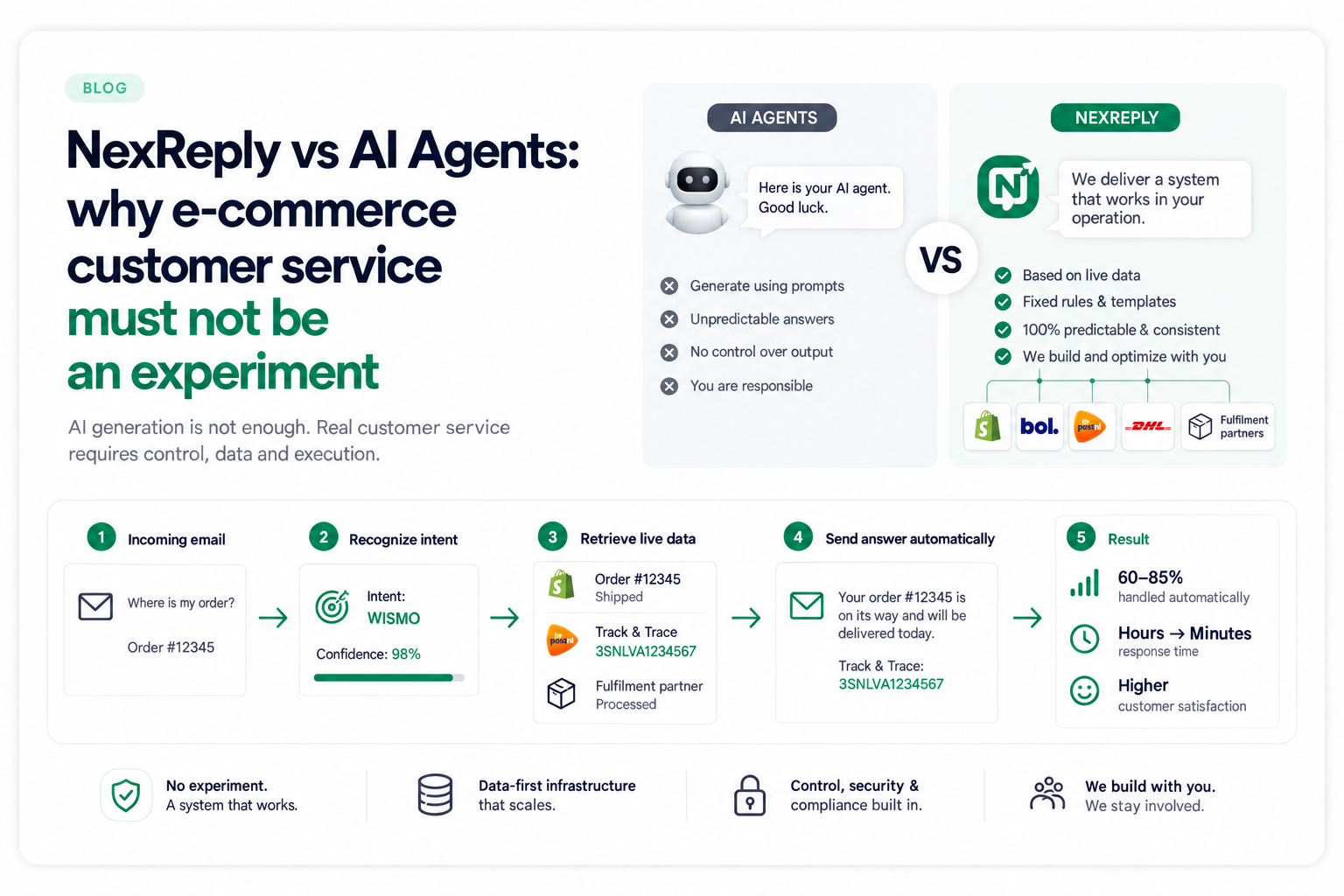
Most AI tools give you a system. NexReply delivers a working operation. AI agents give you a model, integrations and the freedom to generate replies. But in e-commerce, the reality is that you still have to define all the logic, design complex flows, handle exceptions manually and continuously monitor quality yourself.
The fundamental difference: a tool vs a working system
Many AI agents on the market simply function as online tools. You get access to a dashboard and then have to figure things out yourself. NexReply completely reverses that philosophy: we don't deliver a standalone tool; we build a ready-to-use system that works seamlessly within your existing e-commerce operation from day one.
Generation vs execution: data-driven control
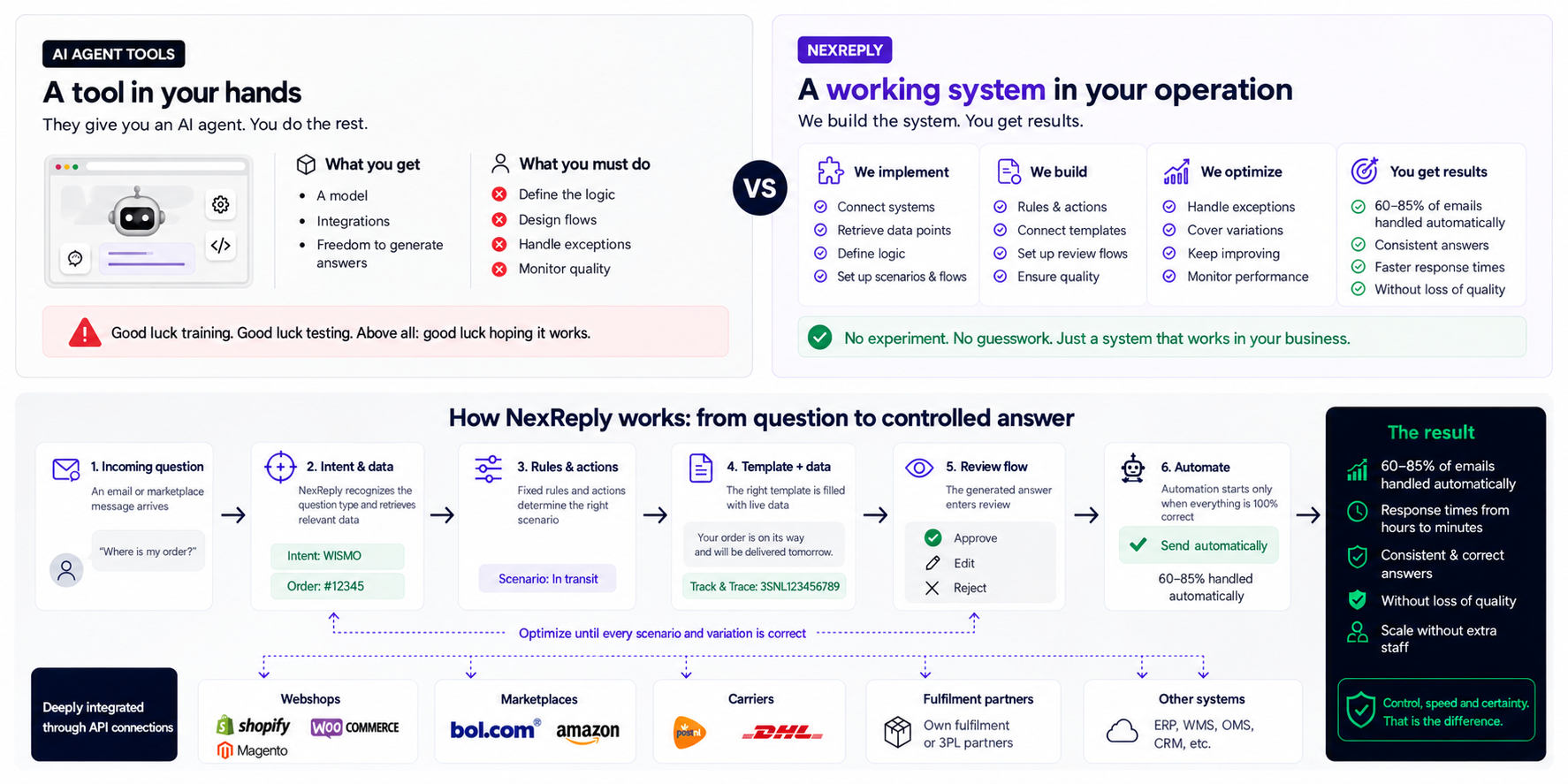
Where traditional AI agents retrieve data to interpret and generate a unique answer on the spot, NexReply chooses absolute safety. Our engine immediately recognises the specific question type, pulls real-time customer data from your systems through direct API integrations, applies your fixed business rules and combines it with controlled templates you have approved. This is fully configured for your business's specific needs.
The strength lies in implementation
A system is only valuable if it communicates with your entire tech stack. NexReply creates stable, deep connections with your online shop, such as Shopify or WooCommerce, marketplaces such as bol.com and Amazon, and fulfilment partners and carriers such as Monta, PostNL and DHL. Most importantly, we configure this entire ecosystem for you, so your team doesn't have to worry about it.
Templates + rules + data = predictable output
In e-commerce support, you don't want variation in replies to logistics status questions. Every NexReply customer flow follows a fixed formula:
Intent: The customer's underlying question is recognised immediately and accurately.
Data source: Integrations retrieve the exact order status and shipping details.
Fixed rules: Specific scenarios, such as delays, guide behaviour predictably.
Template: The output takes the form of a brand-consistent email you have approved.
This creates an accurate process without free interpretation, unnecessary variation or the risk of hallucinations.
The review phase: building until it is 100% right
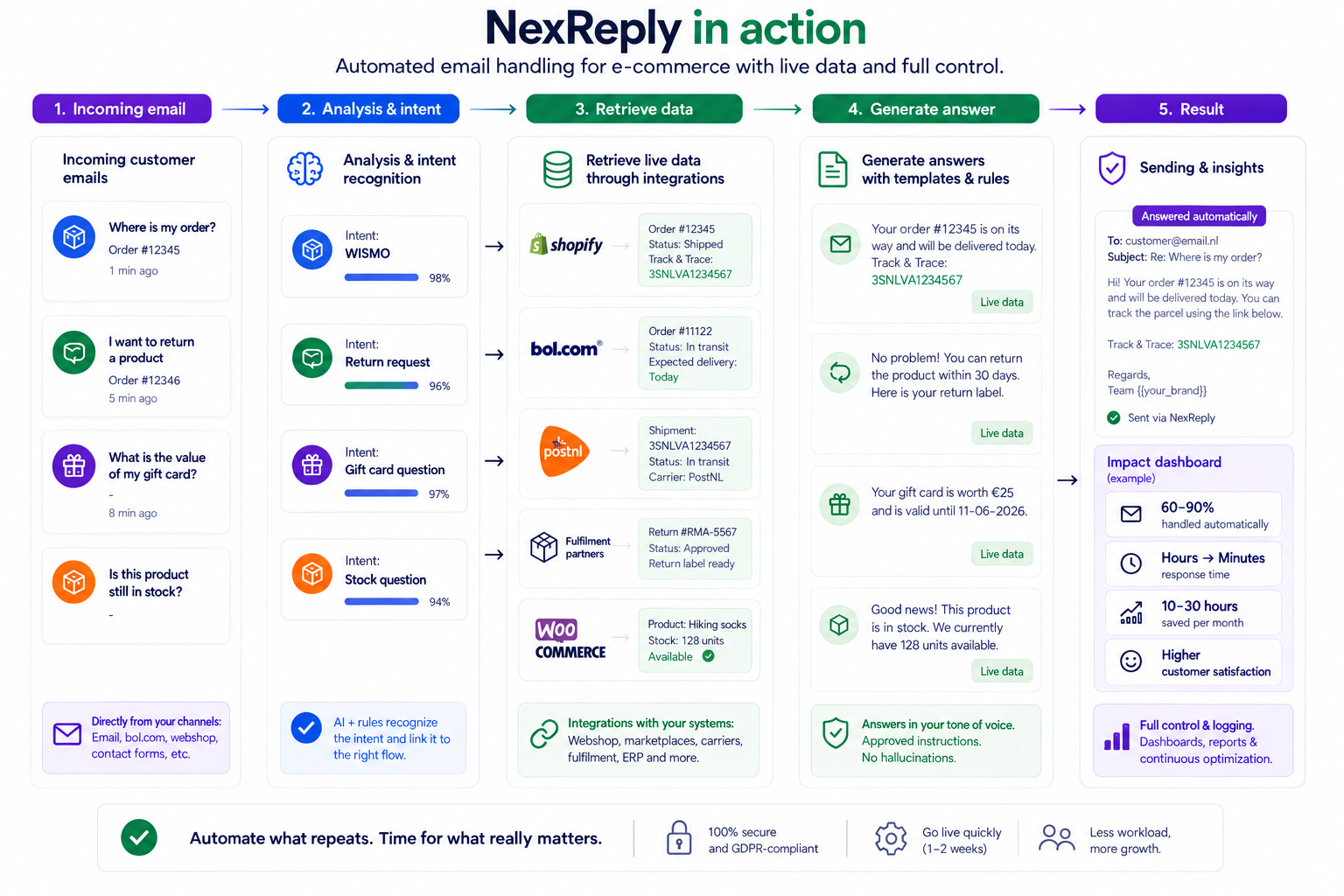
Nobody wants to trust a new AI system blindly. That's why every NexReply project starts in a safe review environment. Replies are generated but not yet sent to customers automatically. Your team reviews and optimises flows iteratively until every possible customer variation is answered correctly. Only then is autopilot enabled.
Why this is crucial in e-commerce
Customer service for online shops is rarely a complicated philosophical debate; it is an operational process. More than 70% of incoming questions follow fixed patterns around delivery times, returns statuses and product information. That repetitive bulk is exactly where you want consistency, speed and absolute operational certainty.
Ownership: who is responsible when things go wrong?
If a traditional AI agent hallucinates or promises an incorrect discount, the full responsibility and damage fall on you. At NexReply, we actively build with you. We ensure all flows are correct, monitor the logic and help you optimise systems every day. Your success is directly linked to our service.
In short: when should you choose which?
Choose NexReply if you:
• Want absolute control over your tone of voice
• Need direct integrations with your e-commerce stack
• Don't have time to build complicated AI flows yourself
• Accept only a guaranteed 0% hallucination rate
Choose an AI agent if you:
• Enjoy experimenting with prompts yourself
• Want exclusively creative, unique replies
• Don't need deep e-commerce integrations
• Want to manage a standalone tool rather than a solution
From onboarding to live in 2 weeks
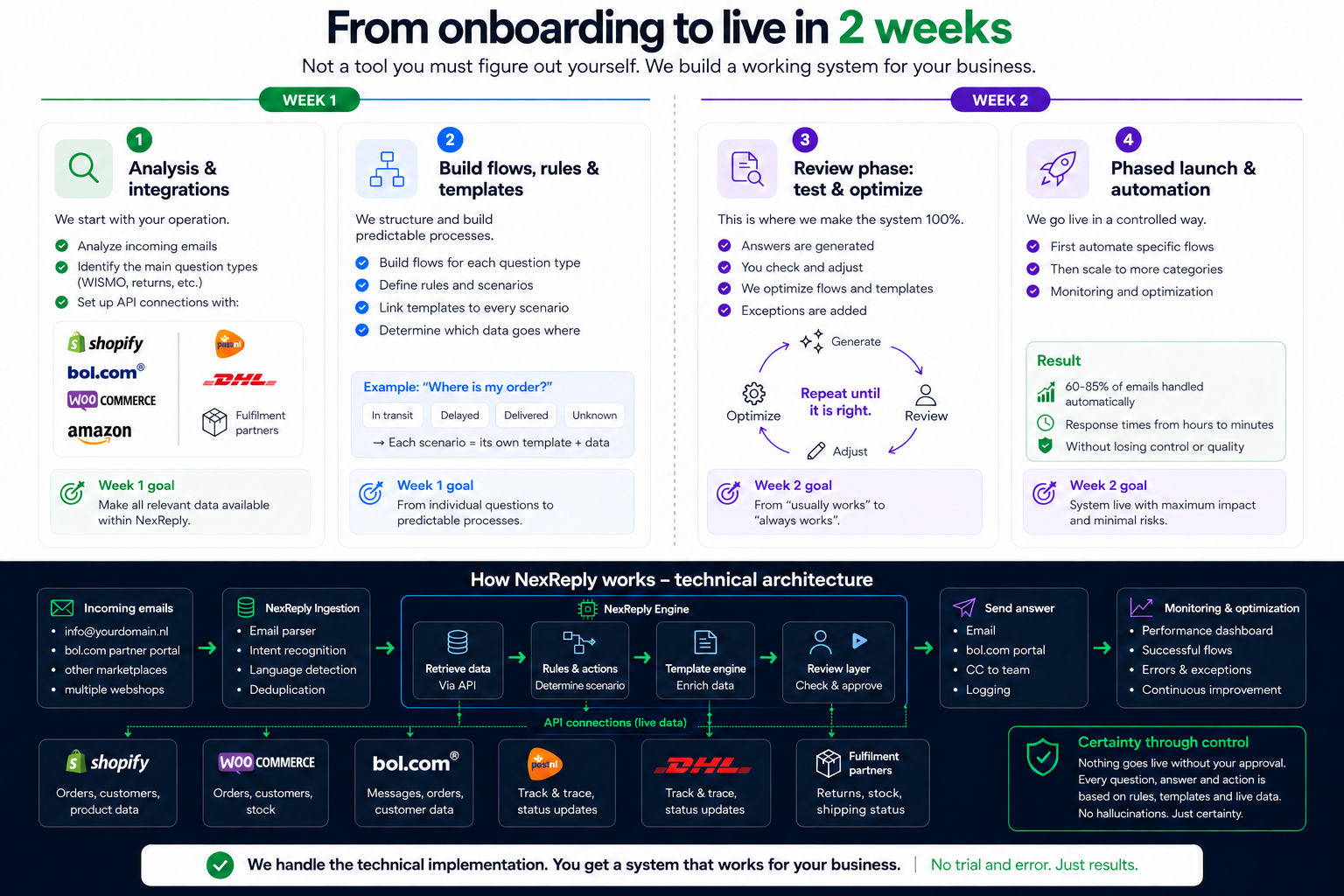
Our onboarding is structured to require as little of your team's time as possible. In Week 1, we conduct an in-depth analysis and establish all necessary API connections. We build the flows, rules and templates. In Week 2, the review phase begins and we fine-tune everything. We then go live in a controlled, phased rollout. The result? Immediately, 60% to 85% of your email volume is answered fully automatically.
Conclusion
AI agents are built on generation and creativity. NexReply is built on control, data and accurate execution. In e-commerce customer service, that control is the difference between a risky experiment and a scalable, cost-saving support operation.
