Connect Your Webshop to Email: Why This Is Crucial for Growth
“Where is my order?” As a webshop owner, you probably see this question appear in your inbox every day. Each email triggers the same routine: look up the order, check the status, write a reply. This takes time, increases workload, and raises the risk of errors.
But this is not a necessary evil. By smartly connecting your webshop to email, you can automate most of this process—not only technically, but also operationally and content-wise. The result: less manual work, faster responses, and customer support that scales with your webshop.
In this guide, you’ll discover:
- what connecting a webshop to email really means
- where most webshops get stuck
- how smart email automation works
- how to automatically handle 80–90% of customer support questions
- and how to do this without losing control
What Does “Connecting a Webshop to Email” Really Mean?
Connecting a webshop to email is more than setting up an info@ address. It means that email communication is directly linked to your webshop data: orders, customers, shipments, and products.
You create one central system where:
- incoming emails are understood
- relevant data is automatically retrieved
- responses are sent consistently and error-free
Without this foundation, automation remains superficial and your customer support cannot scale with your revenue.
The Three Email Streams in Every Webshop
When you connect your webshop to email, you’re dealing with three fundamentally different email streams.
1. Transactional Emails
Order confirmations, shipping updates, and invoices. These are usually already sent automatically via platforms like Shopify, WooCommerce, or Lightspeed. They are essential for trust, but they don’t resolve customer questions.
2. Marketing Emails
Newsletters, promotions, and re-engagement campaigns. These focus on segmentation and consent (GDPR). Important for revenue, but separate from customer support.
3. Incoming Customer Support Emails (the Real Bottleneck)
Every confirmation or campaign triggers questions such as:
- Where is my order?
- Can I return this item?
- Is this product back in stock?
This is where most time is lost—and where automation delivers the biggest gains.
The “Big Three” of Webshop Emails
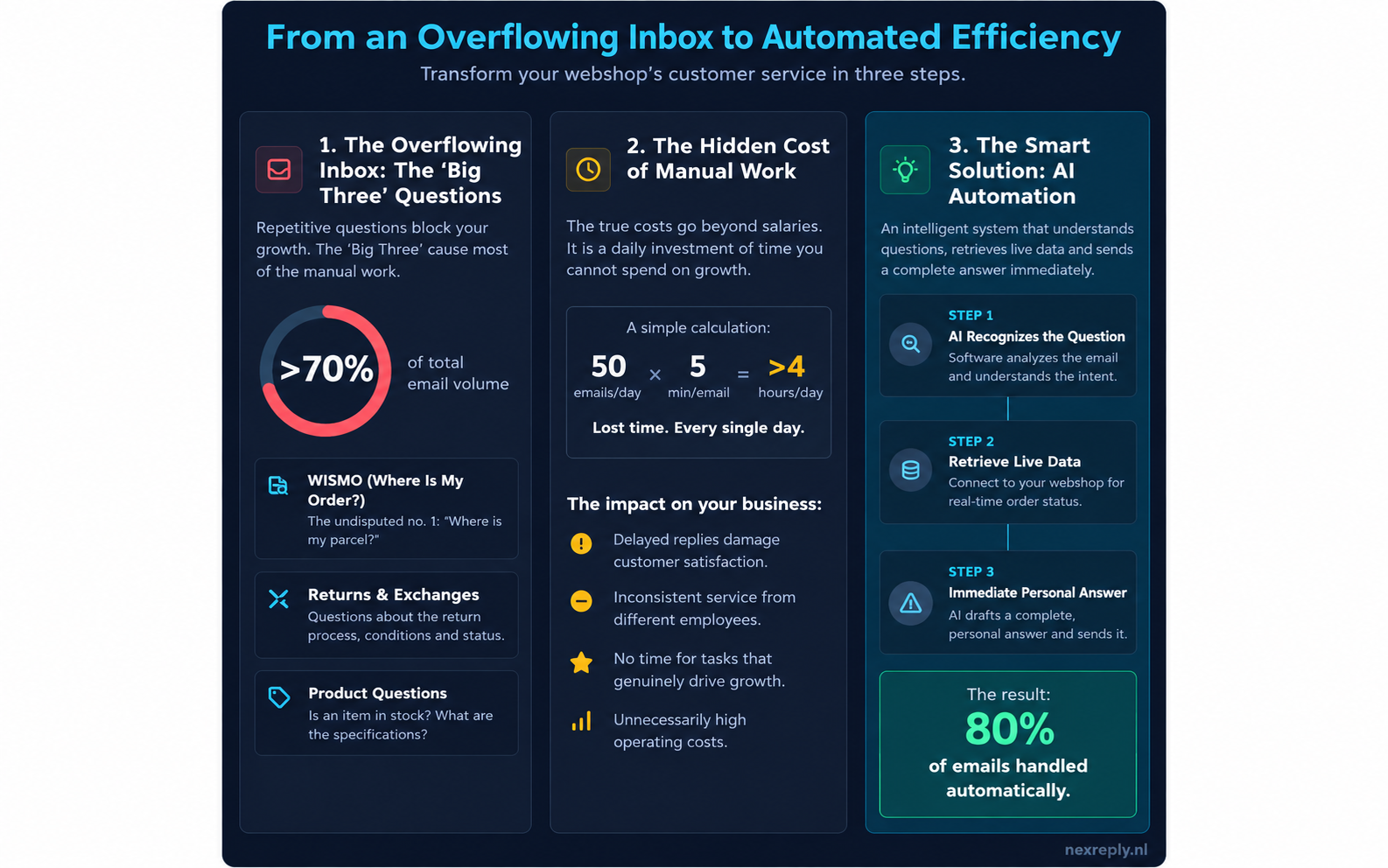
For almost every webshop, 70%+ of incoming emails fall into three categories:
- WISMO – Where Is My Order
- Returns & exchanges
- Product and stock questions
These questions are important to customers, but predictable in content—making them perfect candidates for automation.
Why Manual Handling Doesn’t Scale
50 emails per day × 5 minutes = more than 4 hours per day. That’s time not spent on growth, marketing, or optimization.
There are also hidden costs:
- inconsistent answers
- longer response times
- lower customer satisfaction
- additional staff needed as you grow
A smart approach to connecting your webshop to email is therefore not a luxury, but a necessity.
The Next Step: Email Automation with AI
Smart email automation goes far beyond auto-replies. The system:
- understands the customer’s question
- retrieves live data from your webshop
- sends a complete answer instantly
How Does This Work in Practice?
Step 1 – Intent recognition
The AI determines whether the email is about an order, a return, or a product question.
Step 2 – Fetching live data
Order status, tracking information, return policies, or stock levels are retrieved in real time.
Step 3 – Sending the reply
A complete response, written in your brand’s tone of voice, is sent automatically.
What Are the Concrete Benefits of Email Automation?
- 24/7 instant responses
- Consistent communication
- 80–90% less manual work
- Lower workload for your team
- Higher customer satisfaction
And most importantly: no “AI that just makes things up.”
Connecting a Webshop to Email: The Technical Side
The key is seamless data exchange via APIs. Your webshop, shipping provider, and email environment must communicate securely with each other.
Common Integrations
- Shopify, WooCommerce, Lightspeed
- Shipping software such as Sendcloud
- Customer service email (IMAP / SMTP)
Building this yourself is possible, but complex and maintenance-heavy. A specialized solution is faster, more stable, and future-proof.
NexReply: Email Automation Without Losing Control
NexReply is built for webshops that want to automate email without risk.
Our principles:
- The AI never invents answers
- Responses follow your approved instructions
- Every reply is enriched with live webshop data
- Complex questions are automatically forwarded to a human agent
Assist-first Philosophy
Automation where possible. Human attention where necessary.
Why Choose a Dutch-Based Solution?
- English-speaking software and support, built by a European team
- Deep understanding of European e-commerce logistics and payments
- Customer data stored securely within the EU
- Fully GDPR compliant
From Connecting Your Webshop to Profitable Automation
The connection is just the beginning. The real gains come from smart automation.
With NexReply:
- you automate 80–90% of incoming emails
- you reduce response time by ~75%
- you scale customer support without hiring extra staff
Schedule a free demo and discover how much time your webshop can save.
Frequently Asked Questions
Can email automation be used for any webshop?
Yes. In principle, any webshop can benefit from email automation. NexReply integrates with popular platforms such as Shopify, WooCommerce, and Lightspeed. If you’re using a custom platform, integration is often still possible via an API. During a short intake, we assess your setup and recommend the fastest implementation path.
How long does it take to set up a connection with NexReply?
This depends on your platform and the number of integrations you need (webshop, shipping provider, additional data sources). In many cases, a basic implementation can go live within a few business days. Our team handles the setup, so no technical knowledge is required.
Will I lose personal contact with customers through automation?
No. Automation removes repetitive questions (such as WISMO), giving your team more time for situations that require empathy and custom solutions. Customers receive faster answers to simple questions and better support for complex issues.
What happens if the AI doesn’t understand a customer’s question?
Our AI never guesses. If an email cannot be classified with sufficient confidence or falls outside predefined rules, it is automatically routed to a human agent (fallback). This ensures you always stay in control and every customer receives the correct attention.
Is email automation only for large webshops?
No. Even with just a few dozen emails per day, automation can save hours each week. It also allows you to scale without immediately increasing support capacity.
Does this work for emails beyond order-related questions?
Yes. In addition to order and shipping inquiries, you can automate product questions, return procedures, stock availability, invoice requests, and general service inquiries—as long as you define clear, approved responses. This ensures a consistent customer experience and reduces workload across your entire support operation.